ESI Media
SERVICE/UX │ B2C │ TRAVEL
FLOW CMS Migration
The Problem
The Drupal CMS system at ESI Media (The Independent and the Evening Standard) had been in use for a number of years. Over that time it had become bloated with additional features that were now seldom used, and the platform itself was extremely slow to use.
I took on the lead UX Designer role, tasked at reviewing the new CMS platform being introduced, called FLOW, and working directly with their product team to ensure it was fit for purpose for the journalists and editors at ESI Media.
Ethnographic Studies
Although the ESI Media product team sat alongside journalists and editors, a lot of our user understanding focused on the end consumers. This was our opportunity to truly understand our colleagues and their workflows.
I spent many hours sat at different news desks to understand the ins and outs of how they worked, and what frustrated them about the current CMS setup.
I built journey maps that outlined the current workflows, and identified key usability concerns. It was also eye opening to see how many different tools and platforms were currently used to manage a news desk and ensure articles were managed effectively. Because of the slowness of the Drupal CMS some editors relied on google sheets or notes software to keep track of upcoming articles, rather than relying on the CMS to do the heavy lifting.
Saga determined their current online offering looked and felt dated, thereby impacting their ability to win over, and convert, new customers.
Using Adobe Analytics I uncovered that customers frequently returned to their basket before converting. I redesigned the journey to allow easy moving back and forth without losing context or progress.
Watch redesign showcase reel on YouTube
Understanding the User Base
I was brought in to lead the transformation of Saga’s cruise booking experience, a journey that had become bloated and difficult to navigate due to years of incremental changes. A key challenge was ensuring the new experience would be accessible and intuitive for a broad user base, many of whom have varying levels of digital literacy and unique accessibility needs.
This redesign represented a significant step forward for Saga, touching multiple parts of the business. You can see the transformation in action in the accompanying video – and catch my cameo at 00:36 during a usability session I facilitated.
Stakeholder Engagement
To fully understand the legacy booking flow, I led working sessions with Saga’s leadership team, leveraging their deep knowledge of customer behaviour and internal constraints.
Key insights included:
Technical limitations caused by external API calls, particularly when users explored flight options. These needed to be minimised for both performance and cost efficiency.
Known customer behaviours that had emerged over years – such as returning to a booking multiple times before committing – helped shape the design principles moving forward.
Behavioural Analytics
Using Adobe Analytics, I uncovered that prospective customers frequently returned to review or amend their holiday packages before purchasing. This insight validated that a non-linear, flexible booking journey was essential, customers needed to explore, compare, and ‘tinker’ without losing context or progress.
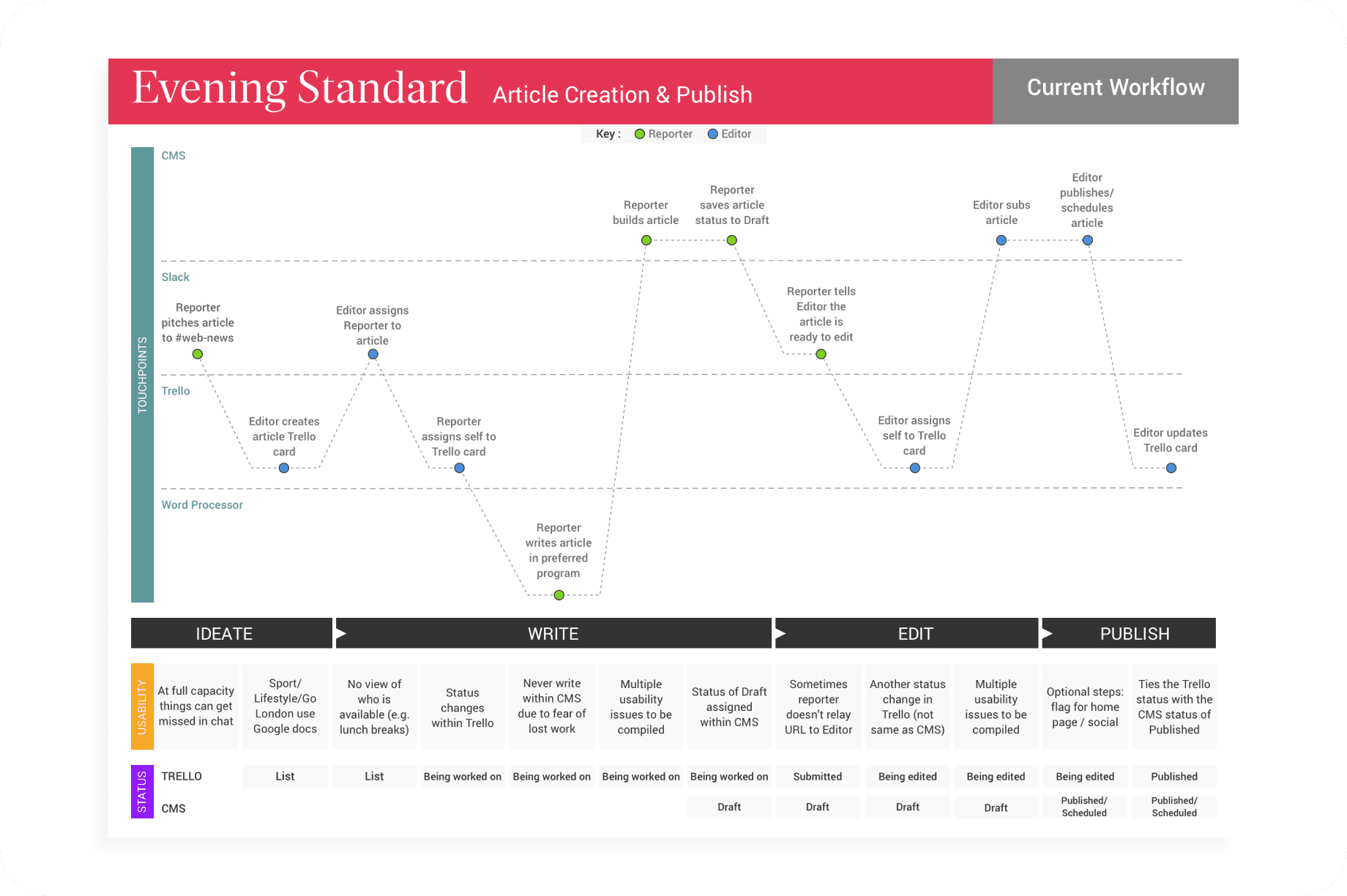
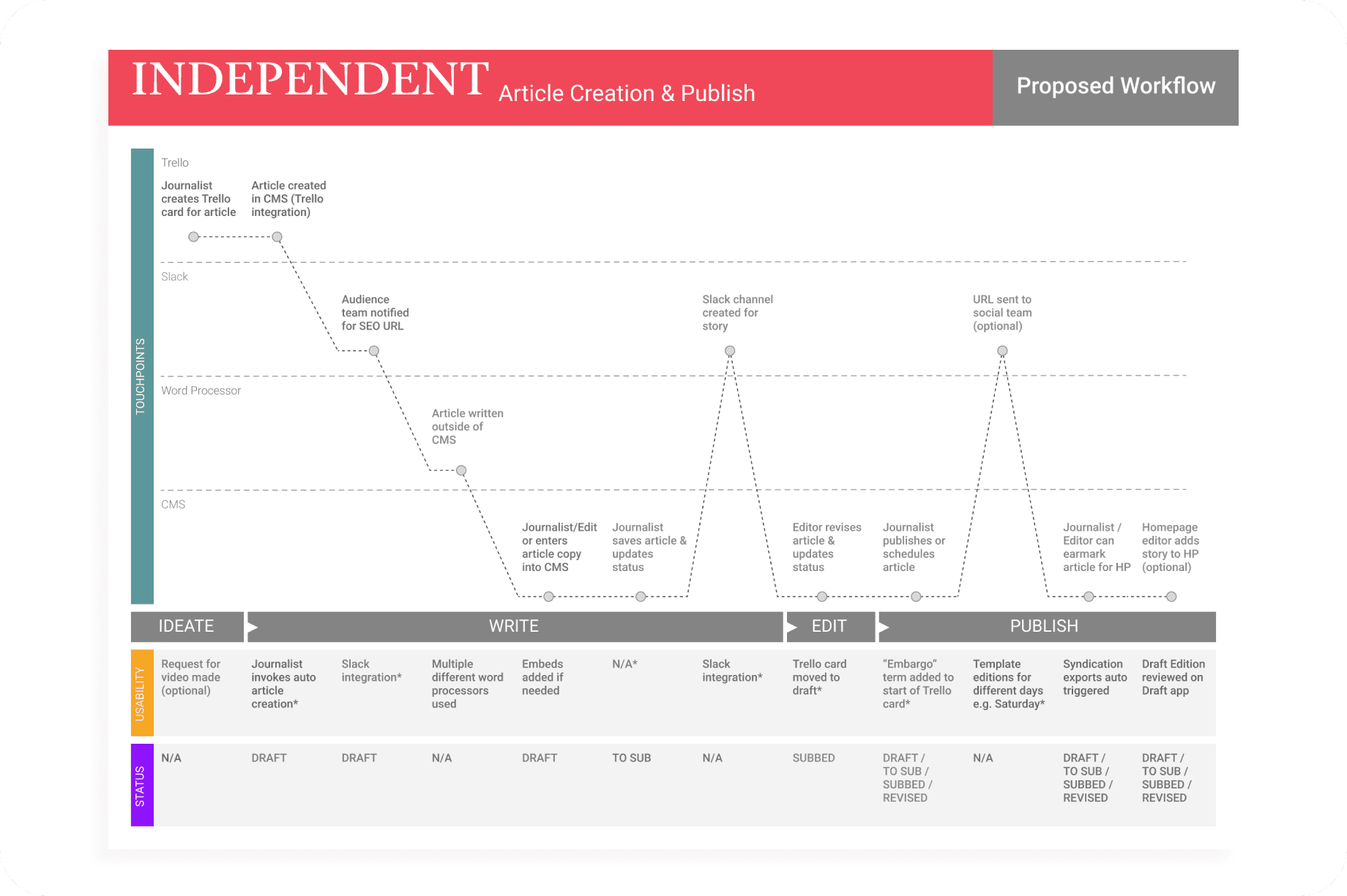
Through rounds of iteration I started to pull together proposed journey maps, which looked not only to solve usability issues but also reduce the cognitive load of switching between platforms.
Instead of relying on sheets and notes I determined that the new CMS must have a robust status workflow, whereby journalists and editors can save drafts, stage them to be published and then be confident that they will go out.
The back and forth between journalists and editors could also be managed directly within the CMS by flagging articles and "ready to be subbed" and/or "revised".
Heuristics Review
Parts of the FLOW platform were being developed as I was better understanding my colleagues. Brightsites, the company building FLOW, gave me access to early development builds to provide feedback.
I undertook early heuristics reviews of all major screens and journeys. This allowed the FLOW development team to catch any major concerns before it got in to the hands of our journalists.
Informed by customer behaviour and aligned with broader efforts across the Saga digital estate, we defined our core design goals:
Simplify the end-to-end booking process
Create a cohesive and consistent UI using shared design patterns
Build a fully accessible journey that satisfies both user and business needs
Leave room for future flexibility and enhancements without requiring structural changes
Technical Alignment
I developed simple, annotated user flows to guide early conversations with product and engineering teams. These flows helped visualise complexity without prematurely introducing design decisions, allowing for clear discussions around system limitations and feasibility.
Ideation and Flow Design
Much of my early ideation centred on the relationship between configuration and confirmation – i.e. how users could select options while still seeing how their full holiday was coming together.
Two main directions were explored:
A linear flow, which simplified the experience but made editing previous selections feel cumbersome
A modular, step-by-step builder, where each section had its own space and updates were reflected in real time
The latter approach better suited Saga’s audience. It allowed customers to navigate freely, revisit decisions, and build confidence throughout. This design also reduced cognitive load and preserved context at every step.
UI Handover and Implementation
I collaborated closely with the UI team to ensure the clarity and breathing space from wireframes translated seamlessly into high-fidelity designs. The updated Saga design language was applied throughout, resulting in a polished, brand-aligned experience that felt consistent across their digital touchpoints.
Usability Testing & Results
We tested the full prototype extensively, and the feedback was consistently positive. The journey was described as clear, intuitive, and modern – with many participants completing it unprompted.
“It’s a doddle.”
“Much easier to use than the existing site.”
“More modern looking... visually this is way more pleasing on the eye.”
“More clear, easy to use and up to date.”
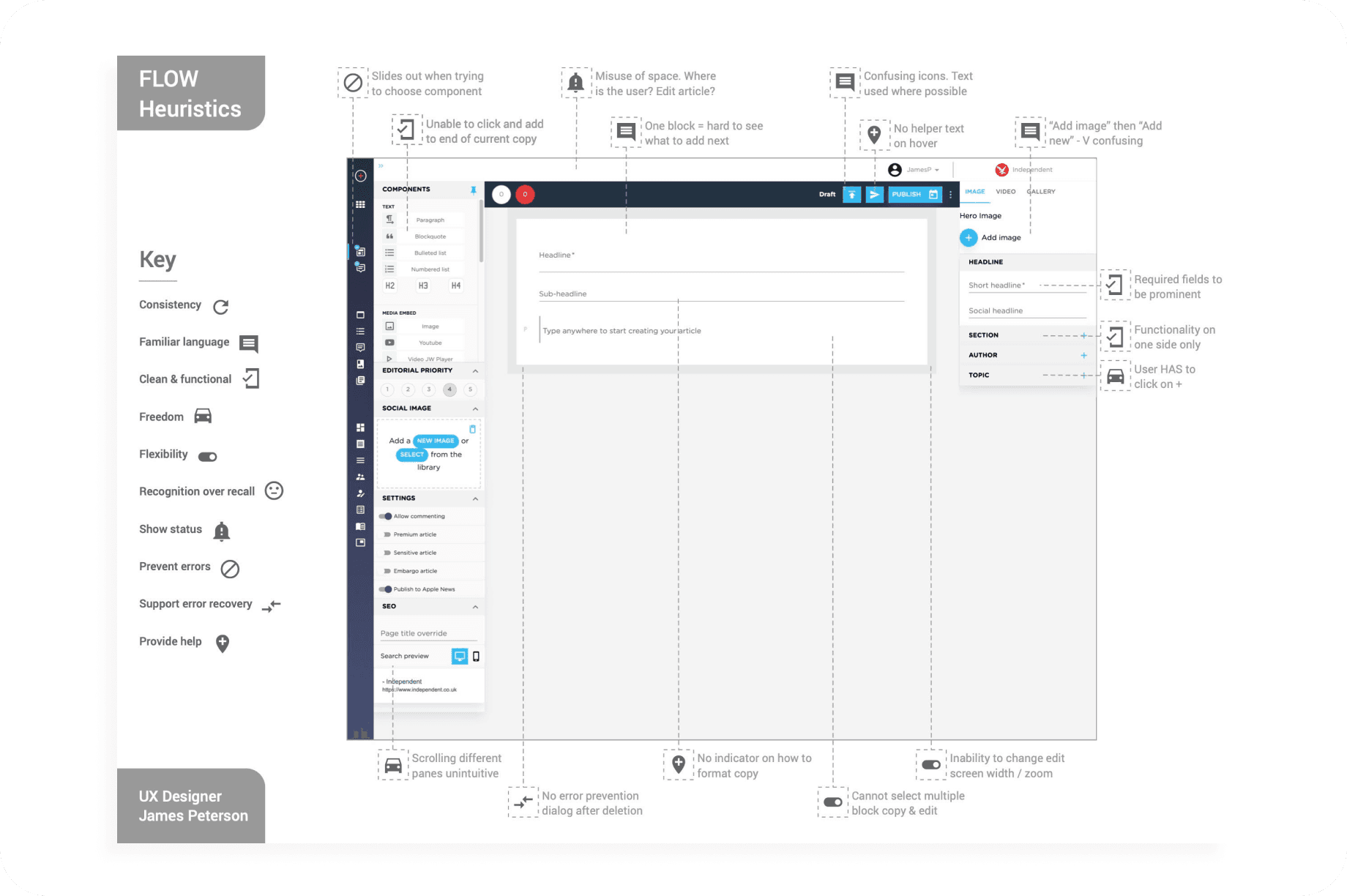
As you can see above it was a combination of poor visual hierarchy, lack of error prevention and other usability issues. I also worked closely with the Brightsites team to optimise the designs for the standard screens used in the ESI Media office.
Card Sorts and IA
I knew that one of the key journeys of a journalist is to actually create an article within the CMS. To ensure they were comfortable doing this directly in the platform, instead of using a less secure platform such as Google Docs, I ran a card sorting exercise to ensure all of the most important formatting options were grouped intuitively. Below you can see the results of that data.
Informed by customer behaviour and aligned with broader efforts across the Saga digital estate, we defined our core design goals:
Simplify the end-to-end booking process
Create a cohesive and consistent UI using shared design patterns
Build a fully accessible journey that satisfies both user and business needs
Leave room for future flexibility and enhancements without requiring structural changes
Technical Alignment
I developed simple, annotated user flows to guide early conversations with product and engineering teams. These flows helped visualise complexity without prematurely introducing design decisions, allowing for clear discussions around system limitations and feasibility.
Ideation and Flow Design
Much of my early ideation centred on the relationship between configuration and confirmation – i.e. how users could select options while still seeing how their full holiday was coming together.
Two main directions were explored:
A linear flow, which simplified the experience but made editing previous selections feel cumbersome
A modular, step-by-step builder, where each section had its own space and updates were reflected in real time
The latter approach better suited Saga’s audience. It allowed customers to navigate freely, revisit decisions, and build confidence throughout. This design also reduced cognitive load and preserved context at every step.
UI Handover and Implementation
I collaborated closely with the UI team to ensure the clarity and breathing space from wireframes translated seamlessly into high-fidelity designs. The updated Saga design language was applied throughout, resulting in a polished, brand-aligned experience that felt consistent across their digital touchpoints.
Usability Testing & Results
We tested the full prototype extensively, and the feedback was consistently positive. The journey was described as clear, intuitive, and modern – with many participants completing it unprompted.
“It’s a doddle.”
“Much easier to use than the existing site.”
“More modern looking... visually this is way more pleasing on the eye.”
“More clear, easy to use and up to date.”
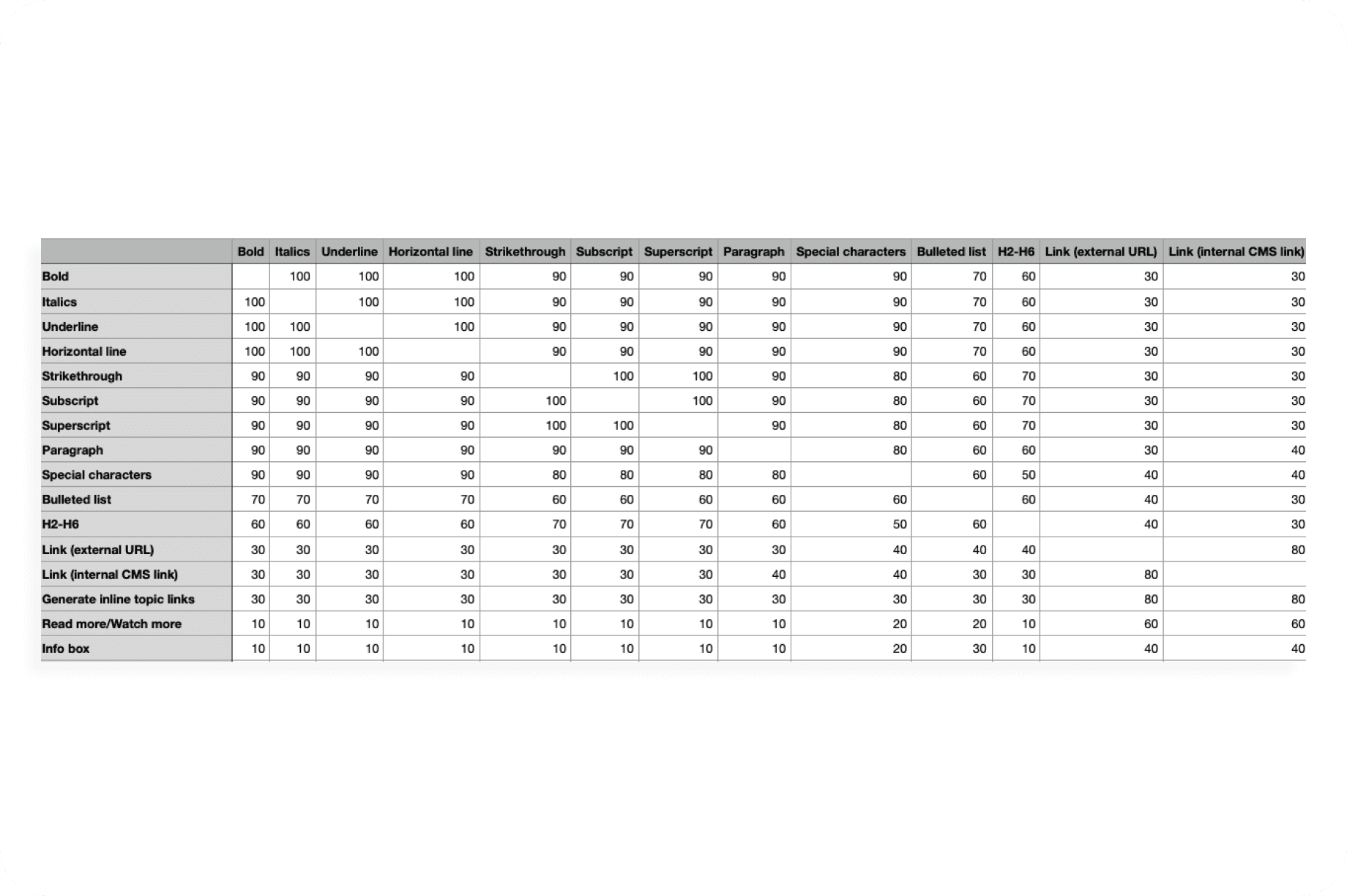
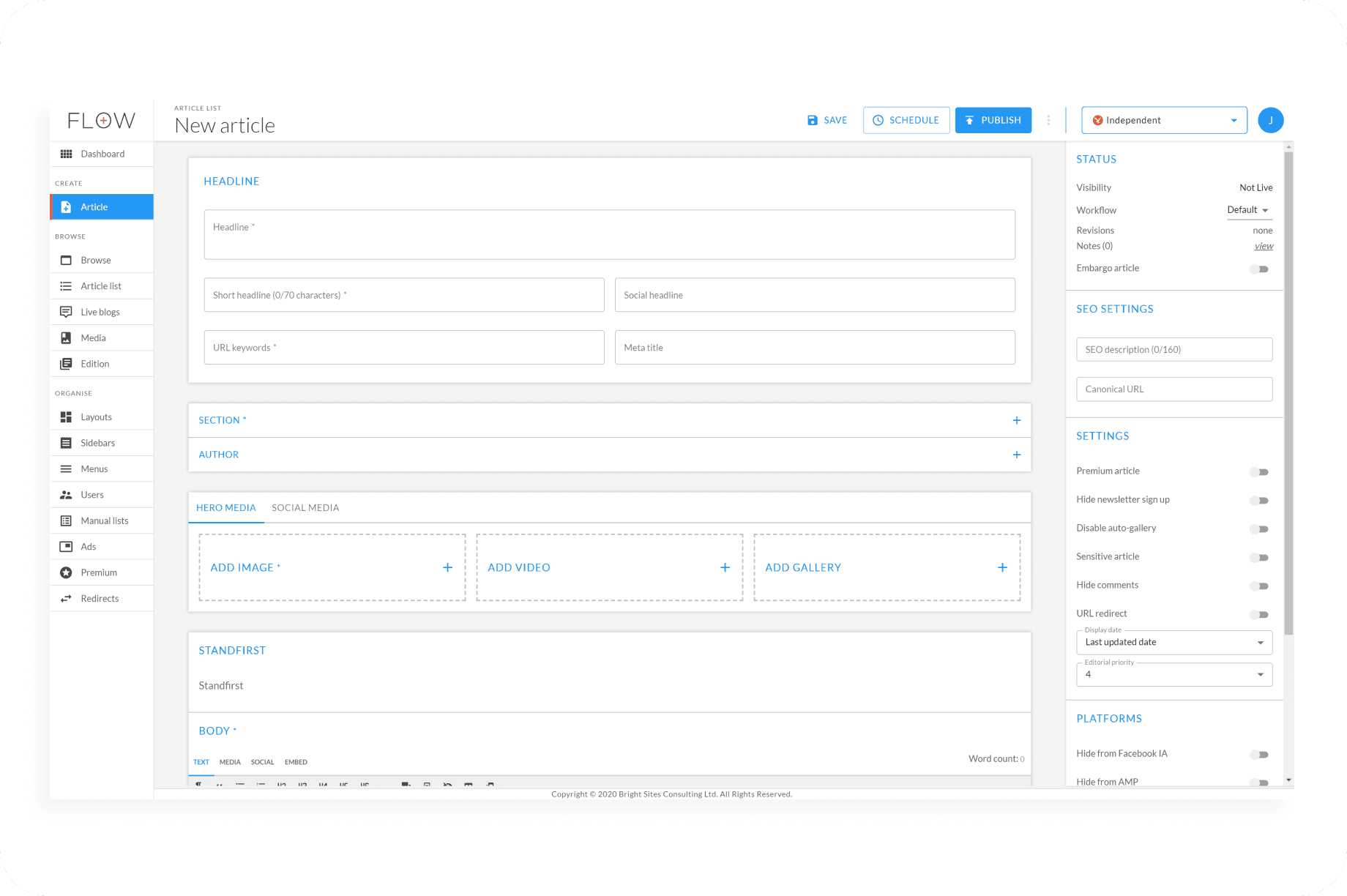
As you can see above the article creation screen changed quite dramatically given my feedback. Now key formatting options were grouped correctly, and the layout of the page more closely represented the mental model of our journalists and editors. A key change was ensuring "required" fields were prominent and obvious, as these needed to be added before an article could be published, and forgetting to add them could lead to publishing delays.
Wireframing and Prototyping
A new part of the FLOW CMS being built exclusively for ESI Media was the home page layout manager. I led the design of this key screen, working closely with senior editors to understand how they would like to visualise this experience.
It was important to mimic the layout of a home page, rather then just rely on a list style view, so that editors could quickly understand how prospective readers will scan the page.
I also pushed to include a drag and drop style interaction, which made adding and removing articles from the home page quick and seamless.
Informed by customer behaviour and aligned with broader efforts across the Saga digital estate, we defined our core design goals:
Simplify the end-to-end booking process
Create a cohesive and consistent UI using shared design patterns
Build a fully accessible journey that satisfies both user and business needs
Leave room for future flexibility and enhancements without requiring structural changes
Technical Alignment
I developed simple, annotated user flows to guide early conversations with product and engineering teams. These flows helped visualise complexity without prematurely introducing design decisions, allowing for clear discussions around system limitations and feasibility.
Ideation and Flow Design
Much of my early ideation centred on the relationship between configuration and confirmation – i.e. how users could select options while still seeing how their full holiday was coming together.
Two main directions were explored:
A linear flow, which simplified the experience but made editing previous selections feel cumbersome
A modular, step-by-step builder, where each section had its own space and updates were reflected in real time
The latter approach better suited Saga’s audience. It allowed customers to navigate freely, revisit decisions, and build confidence throughout. This design also reduced cognitive load and preserved context at every step.
UI Handover and Implementation
I collaborated closely with the UI team to ensure the clarity and breathing space from wireframes translated seamlessly into high-fidelity designs. The updated Saga design language was applied throughout, resulting in a polished, brand-aligned experience that felt consistent across their digital touchpoints.
Usability Testing & Results
We tested the full prototype extensively, and the feedback was consistently positive. The journey was described as clear, intuitive, and modern – with many participants completing it unprompted.
“It’s a doddle.”
“Much easier to use than the existing site.”
“More modern looking... visually this is way more pleasing on the eye.”
“More clear, easy to use and up to date.”
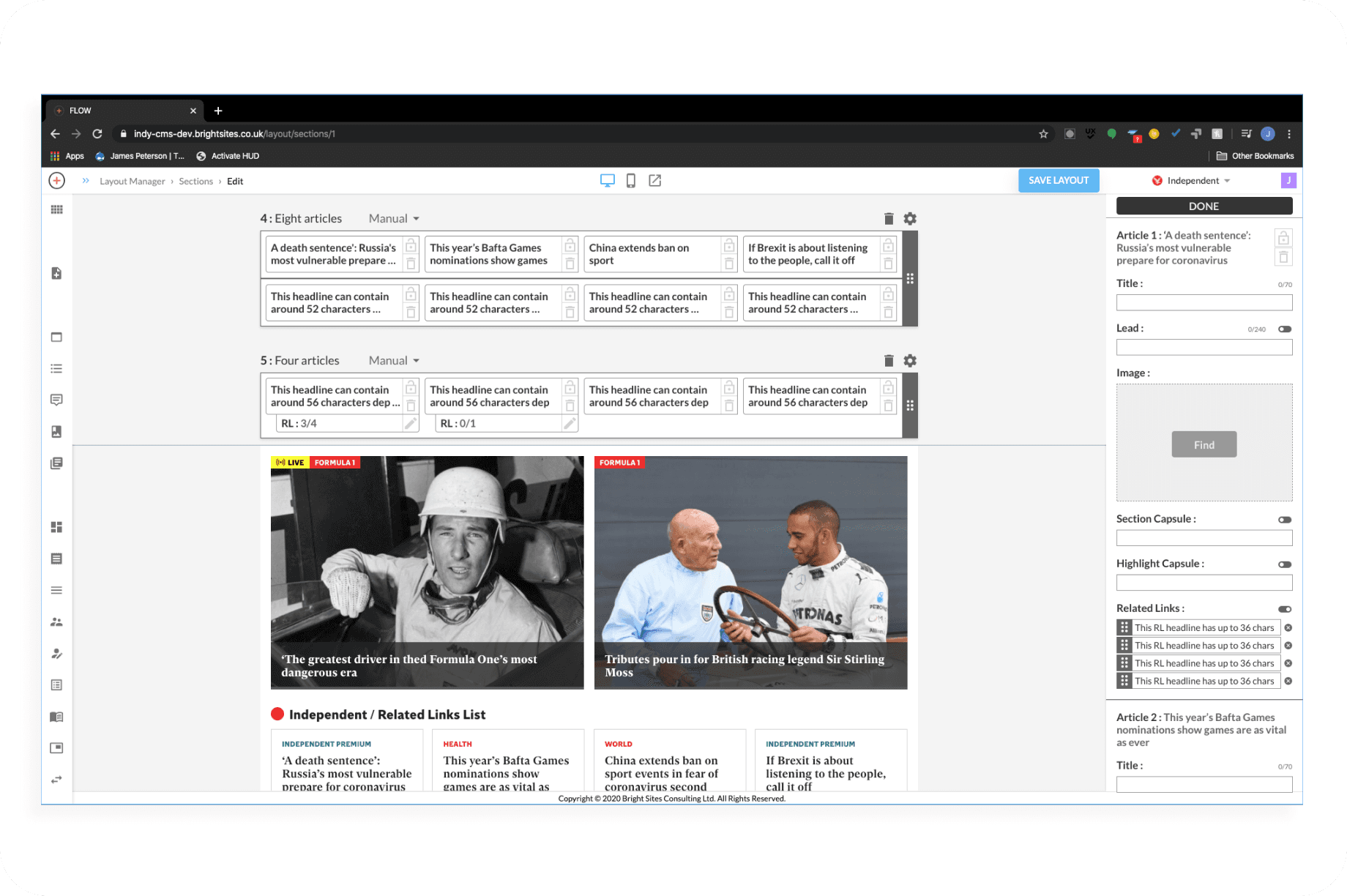
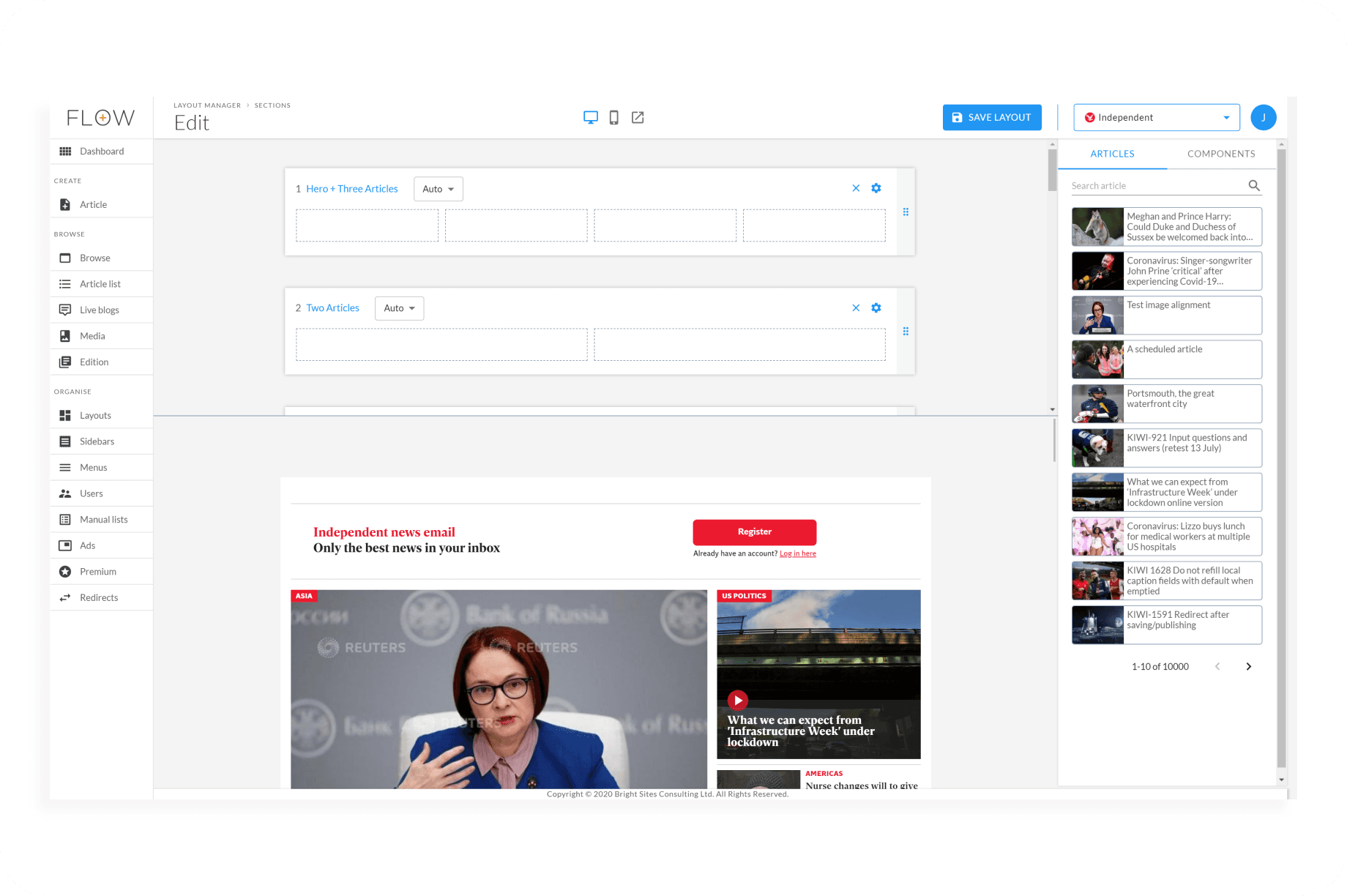
As you can see above the final page closely followed my initial deisgn, even including the multi-pane view, allowing editors to see their home page designs in real time.
Key Results
The response during rollout was overwhelmingly positive:
The redesigned layout manager significantly improved homepage management, reducing the time and effort required by editorial teams.
The updated article creation interface received strong praise, with article publishing time reduced by 30% across the board.
The features I helped design have since been adopted across all of FLOW’s client base, becoming core components of the product.
Some key quotes for journalists and editors:
“The new layout manager is a huge improvement.”
“The whole thing just works better – faster, clearer, smarter.”
“Publishing is no longer a pain – it's actually intuitive now.”
Informed by customer behaviour and aligned with broader efforts across the Saga digital estate, we defined our core design goals:
Simplify the end-to-end booking process
Create a cohesive and consistent UI using shared design patterns
Build a fully accessible journey that satisfies both user and business needs
Leave room for future flexibility and enhancements without requiring structural changes
Technical Alignment
I developed simple, annotated user flows to guide early conversations with product and engineering teams. These flows helped visualise complexity without prematurely introducing design decisions, allowing for clear discussions around system limitations and feasibility.
Ideation and Flow Design
Much of my early ideation centred on the relationship between configuration and confirmation – i.e. how users could select options while still seeing how their full holiday was coming together.
Two main directions were explored:
A linear flow, which simplified the experience but made editing previous selections feel cumbersome
A modular, step-by-step builder, where each section had its own space and updates were reflected in real time
The latter approach better suited Saga’s audience. It allowed customers to navigate freely, revisit decisions, and build confidence throughout. This design also reduced cognitive load and preserved context at every step.
UI Handover and Implementation
I collaborated closely with the UI team to ensure the clarity and breathing space from wireframes translated seamlessly into high-fidelity designs. The updated Saga design language was applied throughout, resulting in a polished, brand-aligned experience that felt consistent across their digital touchpoints.
Usability Testing & Results
We tested the full prototype extensively, and the feedback was consistently positive. The journey was described as clear, intuitive, and modern – with many participants completing it unprompted.
“It’s a doddle.”
“Much easier to use than the existing site.”
“More modern looking... visually this is way more pleasing on the eye.”
“More clear, easy to use and up to date.”
-30%
TIME TO
PUBLISH
-30%
TIME TO
PUBLISH
-30%
TIME TO
PUBLISH
100%
JOURNALIST
SATISFACTION
100%
JOURNALIST
SATISFACTION
100%
JOURNALIST
SATISFACTION